- Published on
LASER Scanner
- Authors

- Name
- Justin James Clayden
LASER Scanner
A novel method for visualising a space
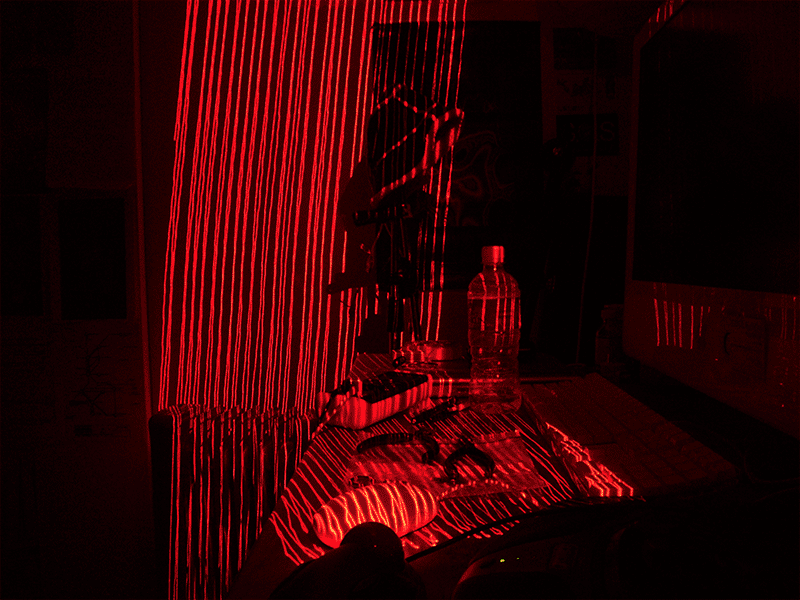
Justy converted a home-made Meccano 2-axis webcam mount into a laser mount. The system is built around an Arduino board that sends timed signals to two servo motors, mounted at right angles to each other. This gives a crude x&y pointer, which can be used to 'draw' patterns on any surface. The desk is illuminated by many vertical sweeps of a 1mW red laser, captured with a Leica C-LUX1 in 60-second extended exposure mode. The project demonstrates Justy's comfort working across embedded programming, physical prototyping, and creative visualisation.

This one is a visualisation of 'Brownian motion'. Brownian motion is analogous to a 'random walk'. The walk is not truly random because the same pattern will be generated every time the system is reset.

This image is a visualisation of the morphology of the 2-axis mount for the laser. It's clear from this image that the unit is more stable when making vertical sweeps than when it makes horizontal sweeps. The increment used for moving the laser also affects the quality of the scan.

Here the laser points along 8 different directions. The unsteadiness mentioned in the previous image is seen along any direction that has a horizontal component. The increment used in this picture is small, so overall the quality of the line is smoother.

The desk is illuminated by an expanding 8-sided spiral. The laser gives a clue as to the type of material it hits -- for example the translucent plastic of a computer versus the opaque wood of the desk.

In a later iteration, Justy added a microcontroller switch to the laser, enabling it to 'pick up the pen' as it were. Super-sneaky sneak preview: here's a random dot pattern, playing across one of his clay sculptures: